A Kakobuy belt that fits the tightest trouser loop
Measure the belt where its layers overlap and check the smallest loop on the actual trousers you want to wear.
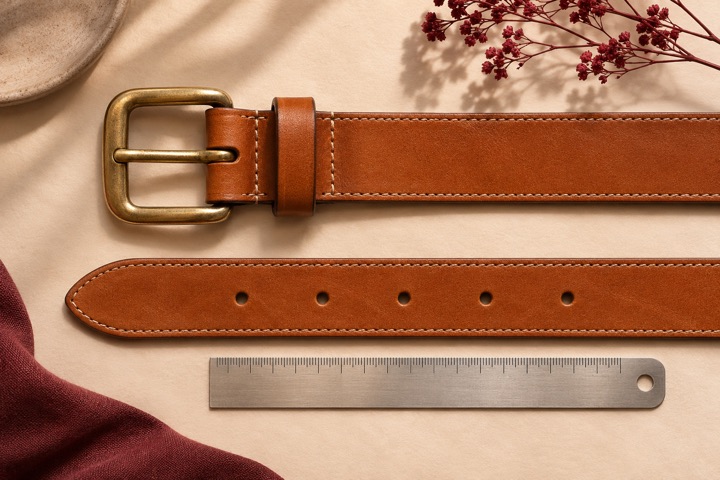
Find the loop that controls the fit
Start with a pair of trousers you expect to wear. Check the side loops and the centre-back loop. Slide strips of firm card through each to identify the shortest opening and any area where the loop lies tight against the waistband. A decorative loop can give you less clearance than the loops around it.
Imagine a 35 mm belt and a loop with 36 mm of clear height. A flat strip of similar width slides through. The tip of the belt, with its folded cross-section, can still jam if the loop sits flat against the trousers. Ask for the width and thickness at the widest part you will have to feed through, including any raised end detail.
Trace the path of the belt before checking the buckle
Set the trousers on your desk and feed an old belt through the loops in your usual direction. Mark where the end folds or overlaps and see whether that thicker section reaches a loop. A keeper fixed to the belt stays by the buckle; a moving metal tip passes through every trouser loop on the route.
If the card that approximates the thickness scrapes heavily on the smallest loop, keep looking for a thinner or narrower strap. If it goes through easily, compare your usual fastening hole and the available holes on the candidate. Save the loop that controlled your decision so the next belt can be checked against the same trousers.